
How to Start Up and Maintain a Swim Spa with Chlorine Granules
Chlorinating a swim spa with dichlor granules works exactly like chlorinating a hot tub — except everything is multiplied. A swim spa holds roughly 1,200 to 3,000 gallons against a hot tub’s 300–500, so every dose, every shock, and every mistake scales with it. This guide walks the traditional hands-on chlorine routine, sized and paced for swim spas.
Want less day-to-day dosing? See the FROG @ease for Swim Spas guide for the self-regulating alternative care path.
Who Chlorine Granules Are Best For
Swim spa owners who don’t mind testing several times a week and want the lowest chemical cost per gallon. Dichlor dissolves fast, works fast, and doubles as its own shock. The trade-offs grow with the water volume: nothing doses automatically, chlorine demand spikes hard after swim sessions, and a lapse in testing shows up as a big, expensive correction. Regular swimmers with a routine do great with granules; hands-off owners are usually happier with the FROG system.
Products and Supplies You’ll Need
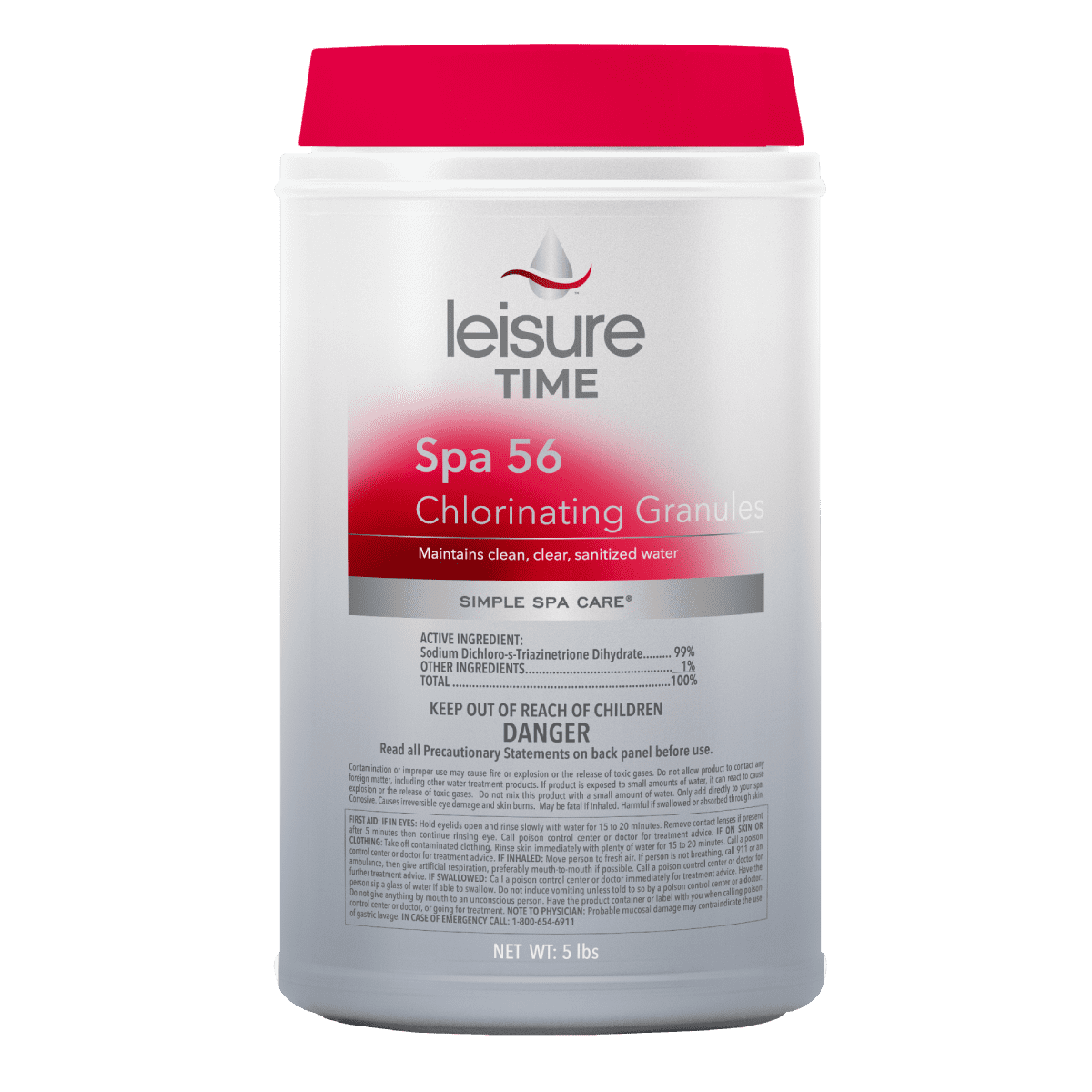
- Leisure Time Spa 56 Chlorinating Granules — 5 lb — at swim-spa volume, buy the big jar (the 2 lb size goes fast).
- 4-way test strips (chlorine, pH, alkalinity, hardness).
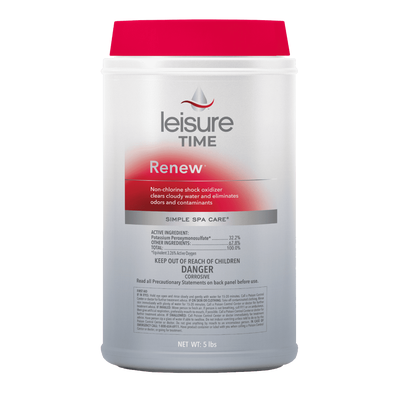
- Leisure Time Renew non-chlorine shock — 5 lb — oxidizes swimmer load without raising chlorine.
- Balancers (expect swim-spa quantities): Alkalinity Increaser, Spa Up, Spa Down, Calcium Booster.
- Hose pre-filter and Metal Gone for the fill.
- Defender scale preventer for hard water.
- Filter cleaner and a high-pressure rinse nozzle.
- FROG Filter Mate mineral stick — optional mineral assist in the filter cartridge.
- TidalFit owner? Your swim spa filters and parts are here.
Step 1: Prep, Fill, and Handle Source Water
- Rinse or replace all filter cartridges (most swim spas run several).
- Check unions, drain plugs, and valves before the water goes in — finding a leak at 2,000 gallons is a bad day.
- Fill through a hose pre-filter. It takes longer at this volume; it also removes proportionally more junk.
- Get your source water tested before or at fill — on well water or any staining history, add Metal Gone right away, dosed for your actual gallons.
- If chlorine demand later seems bottomless, test for phosphates and treat with SeaKlear Free & Klear.
Step 2: Balance Your Water
Balance in this order: Total Alkalinity → pH → Calcium Hardness
Target ranges
Chlorine works best toward the lower end of the pH range. Swim-spa reality: active swimming aerates the water and pushes pH up faster than hot tub soaking does, so expect to trim pH more often than a hot tub owner would. Add balancers in small increments, one at a time, jets on, and retest before adding more.
Step 3: Start Up the Chlorine
With the water balanced and jets running, broadcast Spa 56 across the surface per the label. The label doses 1/2 oz per 500 gallons — so calculate from your swim spa’s actual gallons (a 2,000-gallon spa needs roughly four times the base dose; always follow the current bottle label). Circulate at least 5 minutes, test, and repeat until you hold the label’s 2–3 ppm free chlorine residual. Never enter the water until a test strip confirms the level.
Granules go directly into circulating water only — never into a feeder, floater, skimmer basket, or any FROG cartridge equipment, and never pre-mixed with anything.
Step 4: Testing and Weekly Maintenance
Test 2–3 times per week — plus after every swim session
- Test alkalinity → pH → free chlorine (2–3 ppm target).
- Below 2 ppm? Dose per the label for your gallons, circulate 5+ minutes, retest.
- Swimmer-load rule: a hard 30-minute swim is the contaminant equivalent of a crowd in a hot tub — sweat and oils scale with effort. Test after workouts and expect to dose more on heavy-use days. Under-dosing after exercise is the #1 way swim spas go cloudy.
- Rinse filters weekly (rotate through all cartridges); deep-clean monthly with Leisure Time Filter Clean.
- Hard water? Weekly Defender dose, calculated for your gallons.
Shock every 2–4 weeks — sooner with regular swimmers
Superchlorinate with Spa 56 at the label’s shock rate (1 oz per 500 gallons, scaled to your volume) with the cover off and jets running, or oxidize with Renew non-chlorine shock when you want to burn off oils, sweat, and detergent residue without spiking chlorine. Households that swim daily often oxidize weekly. Stay out until chlorine returns to the 2–3 ppm range.
Foam, oils, and swimwear
Swim spas foam for the same reasons hot tubs do — detergents in swimwear, lotions, sunscreen, and organic load — just with more agitation to whip it up. Rinse swimwear in plain water, shower before swimming when practical, and see the full foaming guide for causes and fixes.
Watch cyanuric acid over time
Dichlor adds cyanuric acid with every dose. It builds more slowly per-gallon in a big vessel, but it builds — when chlorine stops acting right despite normal readings, the water is telling you it’s time for a change, not a bigger dose.
Troubleshooting
Chlorine won’t hold after swim sessions
That’s normal demand, not product failure — oxidize (shock) to clear the swimmer load, then re-establish 2–3 ppm. If demand stays bottomless on idle days, test phosphates and deep-clean the filters.
Strong chlorine smell
Chloramine odor means too little free chlorine, not too much. Shock, ventilate (cover off, jets on), and retest.
Cloudy water
Check balance and chlorine, shock, and rinse or deep-clean every filter cartridge — in swim spas a single loaded cartridge in the rotation can keep the whole vessel dull.
Partial Replacement, and When to Drain
Because a full swim-spa change is a project, partial water replacement earns its keep here: draining a third and refilling fresh dilutes cyanuric acid, dissolved solids, and stubborn contaminant load, often buying months before a full change. When the water stops responding even after a partial change — typically somewhere past the 6-month mark depending on use — do the full reset: run a pipe & jet cleanser (multi-use size) through the plumbing, drain with a utility pump, and refill through the pre-filter. Follow your swim spa manufacturer’s recommended schedule where one is published.
Swim Spa Chlorine FAQs
Related EZ Water Care Guides
FROG @ease for Swim Spas Guide
The self-regulating alternative: a purpose-built floating system for swim spas up to 3,000 gallons that holds a low chlorine level with monthly shocking.
Hot Tub Chlorine Granules Guide
Same chemistry at hot tub scale — for the hot tub side of a dual-zone spa or a separate tub. Doses and quantities differ; the routine rhymes.
Start at the Swim Spa Water Care hub — or browse hot tub systems on the EZ Hot Tub Water Care hub.