
How to Start Up and Maintain a Hot Tub with Chlorine Granules
Traditional chlorine granules (dichlor) are the classic hands-on way to sanitize a hot tub: you test, you dose, you’re in control. There’s no cartridge or floater doing the thinking for you, which makes this the least expensive system to run — and the least forgiving if you skip testing. This guide walks through a fresh-fill startup and a weekly routine that keeps chlorine simple.
Chlorine and bromine are different chemicals with different routines. They are not interchangeable, and chlorine granules must never go into any bromine feeder, floater, or FROG cartridge system.
Who Chlorine Granules Are Best For
Chlorine granules suit owners who use the tub regularly, don’t mind testing a few times a week, and want the lowest chemical cost per soak. Dichlor dissolves fast, sanitizes fast, and doubles as its own shock. The trade-off: nothing doses automatically, so the chlorine level falls to zero if you forget it. If you’d rather have steady, hands-off sanitizing, look at the FROG @ease system instead.
Products and Supplies You’ll Need
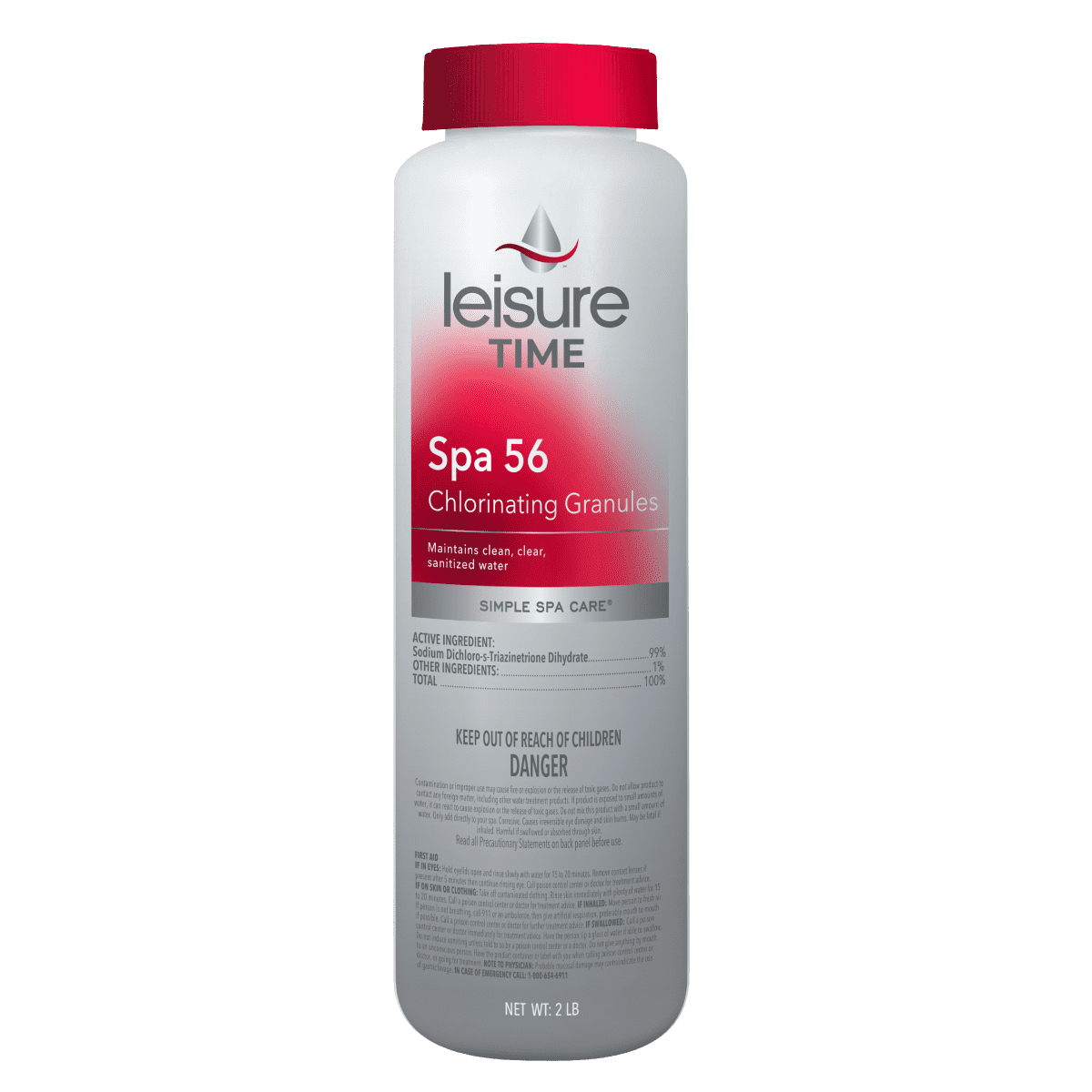
- Leisure Time Spa 56 Chlorinating Granules — dichlor sanitizer (also in a 5 lb size).
- 4-way test strips (chlorine/bromine, pH, alkalinity, hardness).
- Leisure Time Renew non-chlorine shock — oxidizes oils without raising chlorine.
- Balancers: Alkalinity Increaser, Spa Up (pH increaser), Spa Down (pH & alkalinity decreaser), Calcium Booster.
- Hose pre-filter for filling.
- Metal Gone for well water or staining history.
- Defender scale preventer — weekly, if you have hard water.
- Filter cleaner and a high-pressure rinse nozzle.
- FROG Filter Mate mineral stick — optional upgrade that drops into your filter cartridge and adds FROG minerals to a chlorine tub.
Step 1: Prep, Fill, and Handle Metals
Before you fill
- Rinse/clean the filters (or install new ones).
- Open all jets, set valves normally, close the drain, check pump unions and drain plugs.
- If the spa sat unused, purge the plumbing with a pipe & jet cleanser before the fresh fill.
Fill the right way
Fill through a hose pre-filter, through the filter compartment when your manufacturer allows it. On well water or with any staining history, add Metal Gone right after filling. If chlorine demand later seems bottomless, test for phosphates and treat with SeaKlear Free & Klear instead of just adding more chlorine.
Step 2: Balance Your Water
Balance in this order: Total Alkalinity → pH → Calcium Hardness
Target ranges
Fix alkalinity first because it stabilizes pH. The Spa 56 label allows pH up to 7.8, but chlorine is most effective toward the lower end of that range — it loses killing power as pH climbs, so a tub that “smells like chlorine but won’t stay clean” is often just a high-pH tub. Add balancers in small doses, one at a time, jets on, and retest before adding more.
Step 3: Start Up the Chlorine
With the water balanced and jets running, broadcast Spa 56 granules across the surface per the label — the label’s starting dose is 1/2 oz per 500 gallons. Give it at least 5 minutes of circulation, then test. The label’s target is a residual of 2–3 ppm free chlorine; if you’re not there yet, repeat the dose and retest until you are. Calculate every dose from your spa’s actual gallon capacity (it’s in your owner’s manual) and always follow the current bottle label.
Never pre-mix granules with anything, never add them through a feeder or floater, and never enter the spa until the chlorine level has been verified with a test strip.
Step 4: Weekly Maintenance Routine
Test 2–3 times per week
- Test (alkalinity → pH → free chlorine 2–3 ppm).
- When chlorine drops below 2 ppm, add the label’s maintenance dose with the jets on, then retest after 5+ minutes of circulation.
- After heavy bather loads, expect to dose more — oils and lotions consume chlorine fast.
- Rinse filters weekly; deep-clean monthly with Leisure Time Filter Clean.
- Hard water? Add a weekly dose of Defender to prevent scale.
- Wipe the waterline if a ring forms.
Shock every 2–4 weeks (or after parties)
The Spa 56 label calls superchlorination every 2–4 weeks good practice for controlling odors and algae. Superchlorinate at the label’s shock dose (1 oz per 500 gallons) with the cover off and jets running, or oxidize with Renew non-chlorine shock when you want to burn off oils and odors without raising the chlorine level. Either way: cover off, jets on, and stay out of the tub until chlorine is back in the 2–3 ppm range.
Optional: add FROG minerals to your filter
The FROG Filter Mate mineral stick slips into your filter cartridge and adds the same FROG minerals used in the @ease and Serene systems to a traditional chlorine tub. The minerals help control bacteria alongside your chlorine — follow the package directions, and replace the stick every four months or at every drain and refill.
Watch cyanuric acid over time
Dichlor is stabilized chlorine — every dose adds a little cyanuric acid (CYA). Over months, high CYA makes chlorine sluggish even when the strip reads fine. That creeping “the water just won’t act right” feeling near the 3–4 month mark is usually your cue to drain and refill, not to dose harder.
Troubleshooting
Chlorine smell and eye sting
Contrary to instinct, a strong “chlorine” smell usually means too little free chlorine, not too much — the odor comes from spent chloramines. The fix is a shock, not less chlorine.
Chlorine won’t hold
- Shock first — existing contaminants eat new chlorine until they’re oxidized away.
- Check pH; high pH cripples chlorine.
- Test phosphates and treat if high.
- Old water (3–4+ months) with high CYA and dissolved solids — drain and refill.
Cloudy water
Check balance and free chlorine, shock, and rinse or deep-clean the filter. If it recurs constantly, review bather habits (rinse swimwear, shower before soaking) and test phosphates.
When to Drain, Purge, and Refill
Most chlorine-granule tubs run best on a 3–4 month drain cycle — sooner with heavy use, because dichlor’s cyanuric acid accumulates with every dose. Purge the plumbing with a pipe & jet cleanser before draining, and use a utility pump to speed up larger tubs.
Chlorine Granules FAQs
Related EZ Water Care Guides
Traditional Bromine Tablets Guide
The other classic: slow-dissolving tablets in a floating dispenser, with a wider effective pH range and less odor. A completely separate chemistry from chlorine — never mix the two.
FROG @ease Floating System Guide
Want chlorine without the daily dosing? FROG @ease self-regulates a low chlorine level with mineral assist — the easiest upgrade path from granules.
Browse all guides on the EZ Hot Tub Water Care hub.