
Why Is My Hot Tub Foaming? Causes, Solutions and Prevention
Foam on hot tub water is almost never a sanitizer failure — it’s a surfactant problem. Something in the water (detergent, lotion, body oil, cosmetics) is lowering the surface tension, and your jets are whipping it into bubbles that won’t pop. The good news: foam is fixable today and preventable forever, once you know what’s feeding it.
What Actually Causes Hot Tub Foam
Detergent residue in swimwear (the #1 culprit)
Swimsuits carry laundry detergent and fabric softener into the tub, and a hot tub is essentially a washing machine on agitate. One suit’s worth of residue can foam a whole spa. Rinse suits in plain water after every soak — and ideally never machine-wash your “hot tub suit” with detergent at all.
Lotions, oils, cosmetics, and personal-care products
Sunscreen, moisturizer, hair product, deodorant, and makeup all wash off in hot water. They form the oily film that stabilizes foam bubbles and builds the waterline ring. A quick rinse-off shower before soaking removes most of it.
Organic contamination
Sweat and body oils accumulate with every soak. Your sanitizer oxidizes some of it, but under heavy use the load outruns the sanitizer — and the leftovers become foam food.
Old water and high total dissolved solids
Every chemical dose and every soak leaves dissolved solids behind. As TDS climbs over months, water holds bubbles more readily and responds to chemicals less predictably. Foamy, “thick”-feeling water at month three or four is old water, not a product problem.
Dirty filters
The filter is what strips oils and fine particles out of circulation. A loaded filter puts them right back into rotation — cloudiness and foam usually follow.
Low calcium hardness (very soft water)
Very soft water foams more easily — keep calcium hardness in your system’s recommended range (150–250 ppm for most spa sanitizer programs; a calcium booster raises it). If you filled from a water softener, that’s a likely contributor — spa manufacturers, including the Blu Fusion instructions we publish, advise against softened fill water.
Incorrect or excessive chemical use
Some products foam when overdosed — cheap algaecides and clarifiers are notorious — and doubling up on incompatible products makes it worse. Dose by your spa’s actual gallons, per the label, one product at a time. Hot tubs vary in size and water capacity: always follow the dosage instructions on the product bottle for your hot tub’s gallon capacity.
How to Get Rid of Foam Right Now
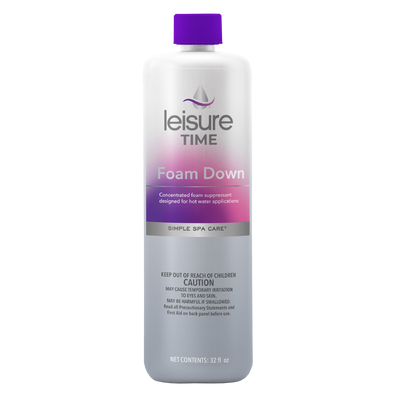
- Knock it down with defoamer. Leisure Time Foam Down (or Softcare Defoam for Softubs) collapses foam in minutes. Understand what it is: a symptom treatment. It doesn’t remove the contaminants — it just stops them from holding bubbles for a while.
- Test and correct the water. Alkalinity → pH → sanitizer level, per your system’s guide. Check calcium hardness too if your fill water is very soft.
- Oxidize. Shock per your sanitizer system’s routine (non-chlorine shock for FROG systems; dichlor or Renew for traditional chlorine/bromine tubs — but never MPS in a Softub, it voids the warranty). Oxidation actually destroys the oils and organics that defoamer only hides.
- Clean the filter. Rinse with a high-pressure nozzle; if it’s been weeks, soak it in Leisure Time Filter Clean.
- Skim the surface — an oil-absorbing sponge pulls the surfactant film out of the water so it can’t re-foam.
Which Fix Does Your Tub Actually Need?
| Situation | The right fix |
|---|---|
| Light foam, water otherwise clear, chemistry in range | Clean the filter, rinse swimwear habits, a dose of defoamer if you’re soaking tonight |
| Foam plus dull or slightly cloudy water | Oxidize (shock) per your system, then clean the filter — defoamer alone will not last |
| Foam returns within a day or two of every treatment | Contaminant load or aging water: shock, deep-clean the filter, and consider a partial drain (one-third to one-half) and refill to dilute dissolved solids |
| Foamy, thick-feeling water at the 3–4 month mark, chemistry hard to hold | Full reset: purge the plumbing with a pipe & jet cleanser, drain with a utility pump, and refill fresh |
The plumbing purge matters more than most owners realize: biofilm and oils line the pipes, and a fresh fill on dirty plumbing inherits the old water’s problems — foam included.
Long-Term Prevention
- Rinse swimwear in plain water; keep dedicated “tub suits” out of the detergent wash.
- Quick shower before soaking — it removes most lotions, oils, and cosmetics.
- Keep up your system’s oxidizing/shock cadence so organics never accumulate.
- Rinse filters weekly, deep-clean monthly, and keep a second set rotating.
- Hold water balance in range — including calcium hardness if your source water is very soft.
- Watch phosphates if water fights you: test and treat with SeaKlear Free & Klear — its enzymes also digest the oils that feed foam.
- Drain, purge, and refill on schedule (about every 3–4 months for most tubs) instead of chasing old water with chemicals.
Foam Rules by Sanitizer System
The oxidizing step differs by system — use your system’s guide:
- FROG @ease Floating and FROG @ease Inline — FROG Maintain non-chlorine shock only (no dichlor shock with @ease).
- FROG Serene Floating and FROG Serene Inline — weekly FROG Maintain.
- Chlorine granules — superchlorinate with dichlor or use Renew.
- Bromine tablets — Renew non-chlorine shock, which also reactivates the bromide reserve.
- Softub Softcare — Softcare Granular Dichlor only; MPS shock voids the Softub warranty.
- Blu Fusion TS salt system — keep phosphates near zero and bromine 3–5 ppm per that guide.
Hot Tub Foam FAQs
Related EZ Water Care Guides
FROG @ease Floating System Guide
Full startup and weekly care for the most popular easy-care sanitizer — including the oxidizing routine that keeps foam away.
Are Ego3 Filters Better Than Traditional Pleated Filters?
Since dirty filters are a top foam cause, filtration upgrades pay off twice. Here’s how the reusable Ego3 approach compares.
Find your sanitizer system’s full guide on the EZ Hot Tub Water Care hub.